REVIEW · WALKING TOURS
Myth of Pejeng Walking Tour
Book on Viator →Operated by Ubud Story Walks · Bookable on Viator
Pejeng is quieter than central Ubud, yet it delivers a full day’s worth of meaning in just 2 hours. I love the mix of sacred sites and pre-Hindu finds, and I really like how the stories tie together the bronze kettle drum and local beliefs into something you can actually picture while you’re standing there. One heads-up: the route includes uneven temple stairs, steep bits, and patchy sidewalks, so you should be comfortable walking and climbing on a real urban-temple path.
In This Review
- What makes the tour feel special
- Quick hits before you go
- Pejeng walking tour in plain terms: what you’re really buying
- How the walk actually works (timing, pace, and what to expect underfoot)
- Temple etiquette and what to do with it
- Stop 1: Pura Penataran Sasih and the Moon-of-Pejeng energy
- Stop 2: Pura Pusering Jagat and the meaning of sacred directions
- Stop 3: Kebo Edan Temple, the Crazy Buffalo statue, and theories
- Stop 4: Arca Building Archaeological Museum and pre-Hindu Bali
- Guides, group size, and why small matters here
- Value check: why $21.40 can make sense in Bali
- Who this tour suits best (and who should choose something else)
- My best advice to make it smoother
- Should you book the Myth of Pejeng walking tour?
- FAQ
- Where is the meeting point and end point for the tour?
- What time does the tour start?
- How long is the walking tour?
- How much does the tour cost?
- What’s included in the price?
- Do I need to bring a sarong for temple visits?
- Is there pickup or drop-off from my hotel?
- Does the tour run in rain?
- How big is the group?
What makes the tour feel special
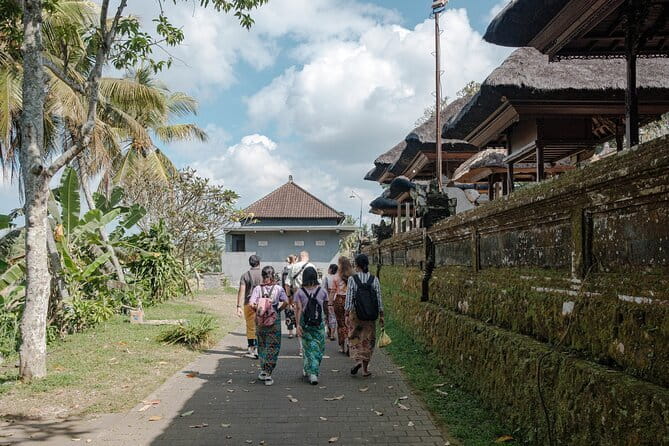
You’re not just ticking off temples. You’re learning how people in this area understand the past, the sky, and sacred space—then you get practical support like sarongs, a guide who answers questions in plain language, and a small group size that keeps the walk from feeling rushed. The only real catch is simple: you start without a hotel pickup, and the weather can affect timing if conditions are severe.
Quick hits before you go
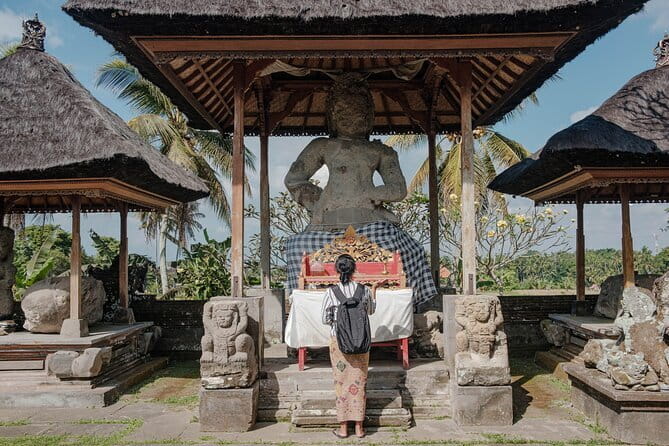
- Small group (max 8) keeps the tour personal, with time to ask questions
- Special access to a Balinese compound adds context beyond what you’d see solo
- Pura Penataran Sasih connects myth to an impressive bronze kettledrum story
- Kebo Edan Temple lets you focus on a recovered 13th-century Bhairawa statue and theories around it
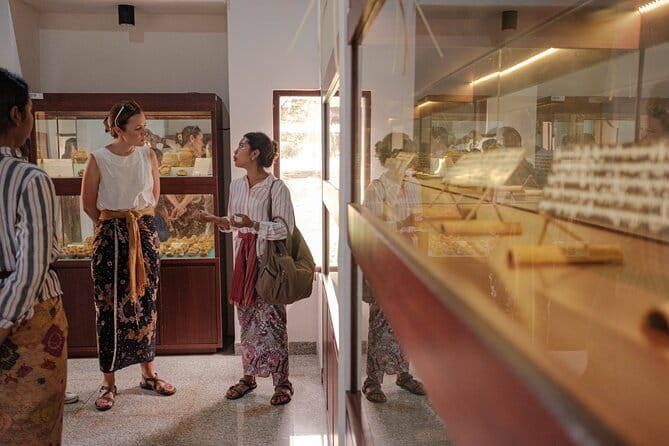
- Arca Building Archaeological Museum shows pre-Hindu Bali with giant sarcophagi in an open courtyard
- Sarong and sash provided, plus a donation (Rp 60,000) and coffee/tea/snack included
You can also read our reviews of more walking tours in Ubud


Pejeng walking tour in plain terms: what you’re really buying
This is a short, guided walking circuit in Bedulu/Pejeng area (near Ubud) built around four stops. At each one, the guide anchors you with a story—religion, local myth, and older layers of history—then you get time to look carefully at what’s in front of you.
The price is $21.40 per person, which is strong value for Bali, mainly because so much is handled for you: admission/donations are included, you get a local English-speaking guide, and you also receive balinese coffee, tea, and a snack. You’re also not stuck on your own with the logistics of temple etiquette. They provide a sarong and sash so you’re covered without last-minute shopping.
The biggest reason this tour is worth it: it doesn’t feel like a generic temple hop. The stops are connected by a theme—myth, sacred direction, and time before Hindu influence—so the walk lands as a coherent story rather than a checklist.
How the walk actually works (timing, pace, and what to expect underfoot)
Plan on about 2 hours walking and exploring, starting at 8:30 am. The tour runs rain or shine, but if conditions turn severe—like an intense downpour—they’ll contact you before the start. That means you should still bring the basics for Bali weather: sun protection, light layers, and a reusable water bottle.
Physically, this is not a sit-down museum tour. You’ll be on uneven temple stairs, steep gradients, and patchy sidewalks. The company is upfront that it’s for people who can handle steps and a walk around an urban environment for up to 2 hours. In practice, that means wearing grippy shoes beats sandals. If you’re unsure, treat the stairs as the deciding factor, not the flat sections.
One more practical detail: there’s no pickup or drop-off from your accommodation. You start at Indomaret Pejeng (Jl. Raya Dr. Ir. Sukarno No. 552, Bedulu, Kec. Blahbatuh, Gianyar) and the tour ends at Museum Arkeologi (F7JV+563, Bedulu, Blahbatuh, Gianyar Regency).
Temple etiquette and what to do with it

Balinese temples are sacred spaces, not tourist stages. The tour follows the rule that both men and women must dress modestly by wearing a sarong that covers the legs below the knee. You can bring your own, or use the sarong and sash provided.
That matters because it changes the vibe. When everyone is dressed correctly, the guide can slow down and explain. You’re also less likely to get side-eyed by staff while you scramble for clothing at the last second.
Also: keep your hands and feet calm. Temples ask for quiet respect, even when you’re learning. The guide helps you get it right.
Stop 1: Pura Penataran Sasih and the Moon-of-Pejeng energy
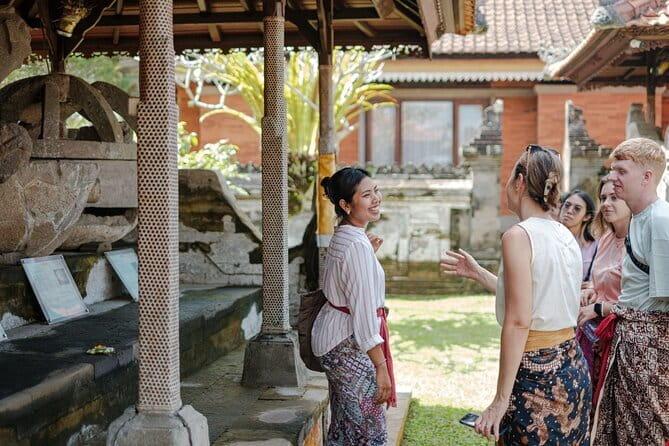
This first stop is the one that pulls the story into focus: Pura Penataran Sasih. You enter as part of a small group wearing traditional sarongs and sashes. The big moment here is access to one of Bali’s oldest temples, including special viewing connected to Southeast Asia’s largest bronze kettledrum.
The guide focuses on local myths—especially the way people interpret signs from the world around them. It’s not mythology as a lecture. It’s mythology as an explanation of why objects and places matter. When you’re standing near the sacred site, the idea feels less like folklore and more like a living reference point for the community.
What I like about starting here: you build curiosity right away. If you’re the type who enjoys asking why something matters, you’ll get momentum within the first 20 minutes.
Possible drawback: since it’s a temple environment, you’ll want to keep your pace steady. Early in the tour is where you set your rhythm for stairs and uneven stone.





Stop 2: Pura Pusering Jagat and the meaning of sacred directions
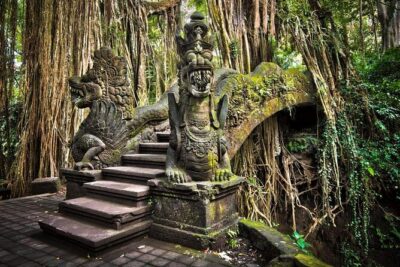
Next is Pura Pusering Jagat, one of Bali’s six main Kahyangan (directional) temples. The tour frames it as a place believed to relate to the island’s center—so the guide gives you a way to think about orientation, symbolism, and how sacred geography shapes religious practice.
You’ll get time for exploration of the temple complex with the guide’s context in your ears. That makes a difference. Otherwise, carved details can turn into just “pretty walls.” With the explanation, you understand what you’re looking at and why people care.
This stop is also a good moment to slow down. Reviews and tour descriptions consistently point to how guides give space for questions, and this is one of the places where that works well. If you want to know how Balinese beliefs connect to daily life, ask here.
Stop 3: Kebo Edan Temple, the Crazy Buffalo statue, and theories

Kebo Edan Temple is often described as the Temple of the Crazy Buffalo. The highlight here is the imposing Bhairawa statue connected to the 13th century. The tour explains that it was recovered from nearby rice fields, and then your guide walks you through theories about its unusual origins.
This stop is fascinating because it’s less about one official story and more about how meaning forms around artifacts. You’re essentially watching people make sense of history through clues in their own landscape.
Why it’s a great stop on this tour: by the time you reach Kebo Edan, you’ve already learned the sacred-symbol logic at the earlier temples. Now you apply it to something recovered and reinterpreted. That arc helps everything click.
Practical note: the temple is smaller, so it can feel crowded if you arrive at peak activity times. Still, with a max group size of 8, your guide can manage movement without turning it into a traffic jam.
Stop 4: Arca Building Archaeological Museum and pre-Hindu Bali

For the final stop, the tour steps back in time with the Arca Building Archaeological Museum. This part shifts the tone from religious ritual to older layers of culture—pre-Hindu Bali.
You’ll explore an open courtyard with giant sarcophagi. This is the kind of stop that gives your brain something new to hold: big stone burial forms, older traditions, and the sense that Bali’s story layers over centuries.
I really like that this ending doesn’t “finish” with a standard temple photo. It broadens your understanding, so you leave with more than temple etiquette and current ceremony—also a feeling for how long the region has been shaping identity.
One consideration: it’s an open-air setting, so plan for sun. Bring water and consider a hat even if you’re arriving early.
Guides, group size, and why small matters here
The tour runs with a maximum of 8 travelers. That’s not just a comfort feature. It changes the whole experience. Small groups mean your guide can actually respond to questions instead of rushing you along.
Across the experience, guides like Joe, Bagus, and Win get singled out for being welcoming and for taking the time to answer questions, including complex ones about moon myths and tantra-related topics. That doesn’t mean you need to be an expert. It means you’ll get plain-language explanations, and you can steer the conversation toward what you care about most.
If you value a calm walk, this size works. If you want the kind of tour where you can pause and ask, this also works.
Value check: why $21.40 can make sense in Bali
Here’s what you’re paying for, in concrete terms:
- Local English-speaking guide
- Expert guided walking tour
- Temples donations (Rp 60,000)
- Balinese coffee, tea, and snack
- Special access to a Balinese compound
- Sarong and sash
When you compare that to what you might otherwise pay for a private guide plus temple entry plus snack plus the hassle of finding and arranging sarong rental, the value stacks up fast. The tour also includes admissions ticket elements for the stops, which is where many “cheap” walking tours quietly cost you more later.
It’s still not a luxury tour. It’s a cultural walk with real stairs and real temples. But the trade is fair: you get story-driven access, not just movement.
Who this tour suits best (and who should choose something else)
This tour is a great fit if you want:
- A morning-friendly way to explore Pejeng without getting stuck in Ubud crowds
- A guided story that connects artifacts, temples, and meaning
- Short walking time with multiple cultural stops (4 in total)
- Hands-on respect: sarong included, temple etiquette handled for you
You might want a different option if:
- You have mobility limits around stairs and uneven surfaces
- You need hotel pickup as a must
- You’re hoping for a mostly flat, stroller-friendly route (this isn’t that)
For first-time Bali visitors who already feel like they’ve seen a few temples but want deeper context, this is especially useful. For repeat visitors, it’s a smart choice because it gives you a different angle—Pejeng’s myths and pre-Hindu artifacts—without eating up your whole day.
My best advice to make it smoother
Go with comfortable shoes. That’s the single most practical move you can make.
Bring a reusable bottle. The tour emphasizes reducing plastic and encourages you to refill water during the day.
And if you can, arrive early enough to check out the local market area before the start. Starting at 8:30 am means you’re in the cooler, livelier part of the morning, and that can add a lot of atmosphere before the guide pulls you into temple time.
Should you book the Myth of Pejeng walking tour?
If you like guided stories that connect place to meaning, book it. For $21.40, you get a small-group walk with admission/donations handled, sarongs provided, and a lineup of four stops that ranges from myth-making bronze to pre-Hindu burial forms.
The decision hinges on your comfort with stairs and uneven ground, plus the fact that you start from a specific meeting point without pickup. If those are fine, this is one of the better “short but meaningful” experiences around Ubud—especially if you want something quieter than the main Ubud circuit.
FAQ
Where is the meeting point and end point for the tour?
You start at Indomaret Pejeng, Jl. Raya Dr. Ir. Sukarno No.552, Bedulu, Kec. Blahbatuh, Kabupaten Gianyar, Bali 80552. The tour ends at Museum Arkeologi, F7JV+563, Bedulu, Blahbatuh, Gianyar Regency, Bali.
What time does the tour start?
The start time is 8:30 am.
How long is the walking tour?
The duration is about 2 hours.
How much does the tour cost?
The price is $21.40 per person.
What’s included in the price?
Included items are a local English-speaking guide, the guided walking tour, temples donations (Rp 60,000), balinese coffee/tea and a snack, special access to a Balinese compound, sarong and sash, and admission tickets for the temple stops.
Do I need to bring a sarong for temple visits?
You must dress modestly with a sarong that covers the legs below the knee. You can bring your own or use a sarong and sash provided by the tour.
Is there pickup or drop-off from my hotel?
No. The tour does not provide pickup or drop-offs from your accommodation.
Does the tour run in rain?
The tour operates rain or shine. If conditions are severe, such as an intense downpour, they will call you before the start.
How big is the group?
The tour has a maximum of 8 travelers.